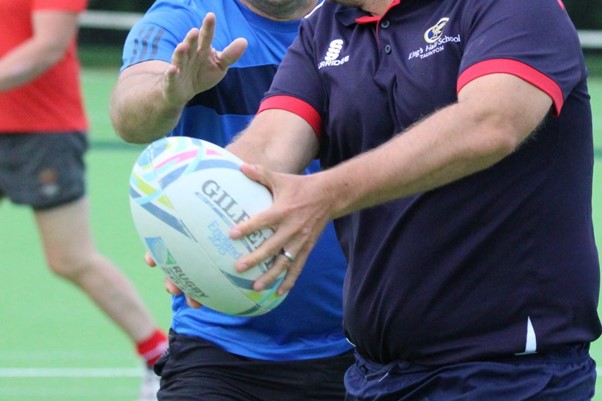
These rules are a simplified version of England Touch Rugby Rules. In recognition that most of those playing Wyvern Touch Rugby are current or former rugby players, the rules have been adapted to allow play to flow and remove some of the elements that really require a referee, allowing the players to ‘self ref’ matches and just enjoy themselves.
- Play starts and restarts at the centre with a “tap”. This is performed by moving the ball on the ground with the foot, free from the hands, and then picking it up. Penalties are performed using the same procedure. On both a re-start and penalty the defending team must retreat at least 10 metres
- Six players are allowed on the field at any one time, with replacements off the field. Replacements can be continuously substituted at any time from one side of the field
- A try is scored by grounding the ball on, or behind, the try-line. One point is awarded for a try
- A touch is legitimate and minimal contact between a player in possession and a defending player. A touch includes contact on the ball, hair or clothing and may be made by a defending player or by the player in possession: an attacking player may affect the touch by deliberately touching the opposition
- When touched, the player in possession must place the ball on the ground at the exact point of the touch: in the event of overrun the player must return to the point of the touch. Play is re-started by stepping over the ball. It can be controlled with a hand or foot. This is known as a rollball. The ball may not roll more than a metre. A player may not perform a rollball unless touched
- The player picking up the ball (the half) may run, but if touched a changeover occurs. The half may not score and a changeover (rollball) will be awarded if this occurs
- After six touches with no score, possession changes. The attacking team begins play with a rollball
- During a roll ball, all defending players must retire to the onside line, 5m back from the roll ball. The defending team cannot move forward until play restarts, nor interfere with play while retreating. A restart occurs the moment the ball is tapped (for a tap) or the half touches the ball (for a roll ball). Players may not delay the game by deliberately delaying a roll ball
- If the attacking player, when making a quick start, is touched by an offside defender, play should continue to see if an advantage can be gained and, if not, then a penalty tap is awarded.
- When a roll ball is taken within 5 metres of the try line the defending players must retreat with both feet to behind their scoreline before they can make the touch. If a player is touched in the in-goal area before grounding the ball the touch counts and play is restarted on the 5-metre line
- If the ball is dropped, knocked forward, passed into touch or if a player crosses the sideline before being touched, a change of possession will occur, restarting with a rollball.
- A penalty is awarded for infringements including: forward pass, offside play, performing a roll ball away from the mark, claiming a touch when none was made, using more than minimum force to make a touch and interfering with the roll ball. When a penalty is awarded, the tap must be taken from the point of the infringement and the defence must retreat at least 10m.
- If the defending team unsuccessfully intercepts the ball or it is intentionally knocked down, the attacking team restarts their possession (‘six again’) with a zero touch. If the interception is successful then the next touch of the ball carrier will be ‘zero touch’
- No obstruction, excessive contact, verbal abuse or foul play will be tolerated. A penalty will be awarded in such cases. Serious or continual foul play of any nature will result in the player being sent off without a replacement